Clustal Omega: The Algorithm Behind Accurate Multiple Sequence Alignment
TL;DR
When you need to align three or more sequences at once — for phylogenetic analysis, variant comparison across isolates, identifying conserved domains, or building sequence logos — the algorithm you choose matters. Clustal Omega (Sievers et al., 2011, Molecular Systems Biology) replaced its predecessor ClustalW by solving two structural problems: slow guide tree construction that scaled poorly with sequence count, and inaccurate profile comparison that degraded on divergent sequences. Clustal Omega's mBed guide tree drops construction from O(N²) to O(N log N), and its profile HMM alignment with Maximum Accuracy (MAC) scoring outperforms ClustalW by 48% on the BAliBASE benchmark (TC score 0.554 vs 0.374). This article explains exactly how it does that, where it still falls short compared to alternatives, and when to reach for MAFFT or MUSCLE instead. AILabAssistant's DNA/Protein Alignment Tool implements Clustal Omega natively — alongside MAFFT, MUSCLE, and four pairwise algorithms — so you can run the right algorithm for your analysis without leaving your workflow.
Picture the scenario: you've sequenced a gene of interest across twelve bacterial isolates and you want to know which positions are conserved and which have diverged. Or you've pulled five homologous proteins from UniProt and need a proper alignment before you can say anything meaningful about their structural relationship. Or your lab is running a genotyping panel and you want to compare twenty PCR products against a reference sequence simultaneously.
This is the world of multiple sequence alignment — and unlike pairwise alignment, which has clean optimal solutions from Needleman-Wunsch and Smith-Waterman, aligning three or more sequences simultaneously is a fundamentally harder problem. The technically correct approach — filling an N-dimensional dynamic programming matrix — becomes computationally infeasible above about four sequences. The algorithms that actually work in practice are all approximations, and the quality of the approximation depends entirely on the design choices made by the people who built the tool.
Clustal Omega is one of the best-regarded of those approximations. Here's why.
What Went Wrong with ClustalW
Before Clustal Omega, the dominant tool was ClustalW (Thompson et al., 1994). ClustalW introduced progressive alignment to the field: rather than trying to align all sequences simultaneously, it aligns them pairwise first to build a distance matrix, uses that matrix to construct a guide tree that determines which sequences are most similar to each other, and then progressively merges alignments from the tips of that tree toward the root. The most similar sequences are aligned first; the more divergent ones are added later.
This works reasonably well on small datasets. The problems emerge at scale — and they're structural, not incidental.
Problem one: guide tree construction. Building the pairwise distance matrix for ClustalW requires comparing every sequence to every other sequence — O(N²) work. At 50 sequences, that's 1,225 pairwise comparisons. At 500 sequences, it's 124,750. At 5,000 sequences, it's roughly 12.5 million. The computation time grows quadratically with sequence count, which wasn't a crisis in 1994 but became an increasingly serious bottleneck as sequencing throughput grew.
Problem two: profile comparison accuracy. ClustalW uses position-specific scoring matrices — essentially frequency tables of which residues appear at each position in the growing alignment — to represent already-aligned groups of sequences. When you add a new sequence to the alignment, you score it against the profile using a relatively simple weighted sum. This works when sequences are closely related. When they're not — when you're aligning sequences from distantly related organisms or paralogs with significant divergence — the profile representation loses too much information and alignment accuracy drops.
Both problems have the same root cause: the underlying statistical model isn't rich enough for the task.
The Clustal Omega Solution
Clustal Omega addressed both problems with fundamentally different approaches.
mBed Guide Tree: From O(N²) to O(N log N)
The guide tree in Clustal Omega is built using an algorithm called mBed (Blackshields et al., 2010). The core insight is that you don't need to compare every sequence to every other sequence to build a reasonable tree — you just need to compare every sequence to a set of carefully selected seed sequences, and use the resulting distance vectors to cluster the sequences.
The process works like this:
Seed selection: Pick log₂(N) seed sequences from the dataset, chosen using a furthest-point strategy to maximize diversity — you pick the first seed randomly, then keep picking the candidate that is farthest from all previously selected seeds.
Sequence embedding: Represent each sequence as a vector of distances to the seeds. If you have 10 seeds, each sequence becomes a 10-dimensional vector. This is the "embedding" step — you've projected your sequences from sequence space into a low-dimensional metric space.
K-means++ clustering: Cluster the sequence vectors using K-means++ initialization (which avoids the poor convergence that random initialization can produce), running the algorithm multiple times and keeping the best result by total cluster cost.
Hierarchical merging: Build a UPGMA tree within each cluster and a UPGMA tree on the cluster centers, then merge the sub-trees into a final guide tree.
The result: guide tree construction costs O(N log N) instead of O(N²). For the 5,000-sequence example above, that's the difference between millions and tens of thousands of pairwise comparisons. For 100,000 sequences — a realistic dataset in genomic epidemiology or evolutionary studies — it's the difference between feasible and not.
One important nuance: mBed is designed for large-scale problems. Below a certain threshold (typically around 100 sequences), the overhead of seed selection and K-means++ clustering isn't worth it, and Clustal Omega falls back to UPGMA directly on the full distance matrix — which is O(N²) but entirely manageable at lab-relevant scales. This is deliberate: for 10 or 20 sequences, UPGMA produces a more accurate tree than mBed's approximation, and the quadratic cost is negligible. The mBed path exists for when you're working at the scale where full UPGMA genuinely becomes a bottleneck.
The mBed approach trades some tree accuracy for speed at large N, and the guide tree itself is less precise than a full UPGMA tree computed from all pairwise distances. But as we'll see, Clustal Omega compensates for this on the alignment quality side.
Profile HMM Alignment: More Signal, Less Noise
This is where Clustal Omega makes its most significant improvement over ClustalW.
Instead of representing aligned sequence groups as simple position-specific frequency matrices, Clustal Omega builds profile Hidden Markov Models for each group. A profile HMM captures not just which residues appear at each position, but the full probabilistic structure of the alignment — the likelihood of match states, insert states, and delete states at every position, with properly calibrated transition probabilities between states.
The alignment step uses a HHalign-inspired approach (from Söding 2005, Bioinformatics): rather than aligning a sequence against a profile, you align a profile against a profile. Both the query group and the target group are represented as HMMs, and the alignment finds the optimal correspondence between the two probability distributions. This is more computationally demanding than simple profile matching, but it captures far more information — particularly about which positions are genuinely conserved versus which just happen to have matching residues by chance.
The Forward-Backward algorithm (not just the Viterbi path) computes posterior probabilities that each pair of profile states is aligned — the probability of this particular correspondence given all possible ways the two profiles could be aligned. This gives a much richer picture of alignment uncertainty than Viterbi alone.
Maximum Accuracy (MAC) Alignment
Viterbi gives you the single best alignment path through the HMM. Maximum Accuracy (MAC) alignment instead uses the posterior probabilities from the Forward-Backward pass to select a path that maximizes the expected number of correctly aligned pairs — not the joint probability of the single best path, but the sum of individual pair probabilities across the alignment.
The distinction matters when the alignment landscape has multiple plausible solutions of similar likelihood. Viterbi picks one and commits to it, potentially missing residue pairs that are highly probable individually even though no single complete path captures all of them. MAC keeps a weighted mixture, which tends to produce alignments with fewer gross errors at the cost of occasionally introducing slight ambiguity at well-supported positions.
On the BAliBASE benchmark — a curated dataset of structurally verified multiple sequence alignments used as ground truth for evaluating MSA algorithms — Clustal Omega with profile HMM alignment and MAC scoring achieves a Total Column (TC) score of 0.554 compared to ClustalW's 0.374, according to the original Sievers et al. (2011) publication. A TC score measures the fraction of alignment columns that are completely correct (every residue in the column correctly placed). A 48% improvement in fully correct columns, not marginal quality gains.
Where Clustal Omega Is Not the Right Choice
Clustal Omega is not the best tool for every alignment problem. Being honest about this is more useful than a blanket recommendation.
Very small datasets (3–5 sequences, high similarity): For a handful of closely related sequences, MAFFT's FFT-based approach or MUSCLE's iterative refinement can be faster without a meaningful accuracy penalty. Clustal Omega's overhead — building the mBed tree, constructing profile HMMs — is better justified as N increases. For three sequences with 90% pairwise identity, the extra infrastructure doesn't buy you much.
Speed-constrained high-throughput pipelines: MAFFT in FFT-NS-1 mode is substantially faster than Clustal Omega at the cost of some accuracy. If you're running alignment as a preprocessing step in a pipeline that needs to handle thousands of alignment jobs—not thousands of sequences per alignment—MAFFT's throughput advantage can outweigh Clustal Omega's accuracy advantage.
Iterative refinement scenarios: MUSCLE's three-stage approach — draft alignment, improved guide tree from the draft, iterative tree-partition refinement — can match or exceed Clustal Omega on moderate datasets (3–100 sequences) with moderate divergence (30–70% pairwise identity). MUSCLE is specifically designed for this regime.
Whole-genome alignment: None of the tools discussed here are appropriate for aligning megabase-scale genomic sequences. BLAST and FASTA handle localized similarity search; whole-genome alignment requires specialized tools like MUMmer, Mauve, or progressiveMauve that are purpose-built for chromosomal-scale data.
How It Compares to MAFFT and MUSCLE
A practical comparison for the typical lab MSA use case:
| Criterion | ClustalW | MAFFT | MUSCLE | Clustal Omega |
|---|---|---|---|---|
| Guide tree complexity | O(N²) | O(N²) | O(N²) | O(N²) for N≤100, O(N log N) for N>100 |
| Alignment model | Position matrices | FFT k-mer scoring | Progressive + iterative | Profile HMM |
| Accuracy (BAliBASE) | Baseline | Good | Good | Best |
| Speed at N=100 | Moderate | Fast | Fast | Moderate |
| Speed at N=10,000 | Poor | Good | Good | Good |
| Handles divergent sequences | Poorly | Moderately | Moderately | Well |
| Iterative refinement | No | Optional | Yes | Optional |
The short version: for publication-quality alignments, phylogenetic analysis, and datasets with divergent sequences, Clustal Omega is the standard. For high-throughput preprocessing where speed matters more than last-decimal accuracy, MAFFT. For moderate datasets with moderate divergence where you want iterative refinement without the HMM complexity, MUSCLE.
What the Guide Tree Artifact Problem Means in Practice
One thing all progressive MSA algorithms share — Clustal Omega included — is guide tree dependence. The order in which sequences are aligned affects the final result: once you've aligned two groups and introduced gaps, those gaps are largely locked in. Errors made early in the progressive process (from an inaccurate guide tree) propagate through the rest of the alignment.
Clustal Omega's mBed tree is faster than ClustalW's but less accurate than a full-distance tree — so for datasets where the guide tree quality matters most (highly divergent sequences, datasets with long branches), the HMM alignment quality needs to compensate. It usually does, but it's worth knowing that Clustal Omega is not immune to the guide tree problem that affects all progressive methods.
The solution — when alignment quality is absolutely critical — is iterative refinement: run an initial alignment, re-compute the guide tree from that alignment, re-align. Clustal Omega supports configurable iteration rounds. Each iteration round takes additional time but can recover from guide tree errors.
What This Looks Like in AILabAssistant
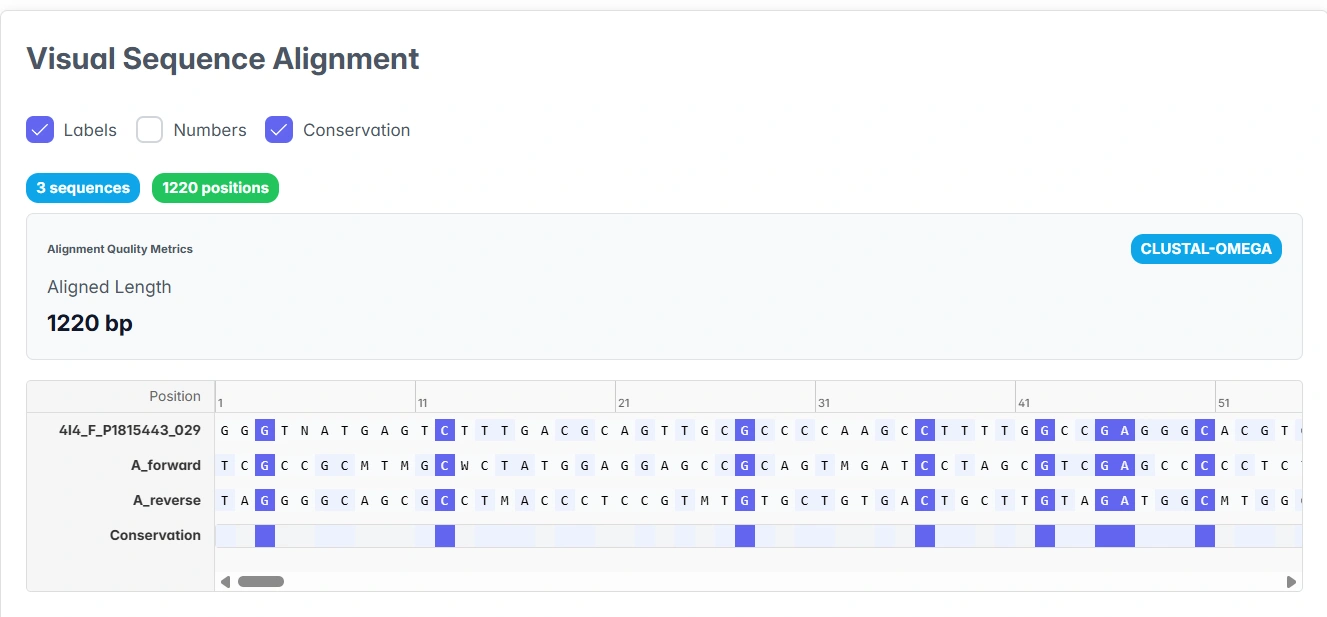
The DNA/Protein Alignment Tool in AILabAssistant includes Clustal Omega alongside MAFFT, MUSCLE, and four pairwise algorithms (Needleman-Wunsch, Smith-Waterman, FASTA, BLAST). When you add a third sequence to the alignment input, the tool automatically switches to Clustal Omega — because pairwise algorithms don't apply to multi-sequence problems, and Clustal Omega is the right default for situations where you haven't specifically chosen otherwise.
You can run the tool on both DNA/RNA sequences and protein/peptide sequences. The underlying algorithm adjusts automatically: for proteins, it uses the BLOSUM62 substitution matrix; for DNA, the IUB matrix. The guide tree construction, k-tuple distance calculation, profile HMM construction, and MAC alignment all run in the browser — no external API call, no server-side processing, no sending your sequence data to a third-party service.
The algorithm selector shows you not just which algorithms are available but explains the trade-offs in plain language: time complexity, accuracy characteristics, appropriate use cases. If you want to run MAFFT or MUSCLE instead of Clustal Omega, you select it explicitly. The tool is opinionated enough to give you a useful default and transparent enough to show you what's happening when you deviate from it.
Alignment results can be exported in FASTA format, saved to your Document Management System, or linked to a bioregistry entry — so the alignment you ran on a gene family today is the same alignment referenced in your project record six months from now, not a reconstructed version from a file that may or may not be the right one.
The Practical Implication
The reason alignment algorithm choice matters isn't academic. An MSA with a TC score of 0.374 — ClustalW territory — means that more than 60% of your alignment columns contain at least one incorrectly placed residue. If you're using that alignment as the basis for inferring evolutionary relationships, identifying functionally conserved positions, or training a downstream model, those column errors propagate. They're not random noise that averages out. They're systematic errors correlated with the regions of the alignment where sequences are most divergent — exactly the positions that contain the most interesting biological information.
Moving to an alignment where 55% of columns are completely correct, with the remaining errors better distributed, isn't a marginal improvement in bioinformatics aesthetics. It's a meaningful change in which biological conclusions your downstream analyses can support.
You probably already have sequence data in your lab where a cleaner alignment would change your interpretation of the results. The question is whether the tools you're using are giving you the best alignment that's achievable, or whether you're working with whatever the default in a desktop viewer happened to produce.
Try the DNA Alignment Tool with your own sequences. Drop three or more sequences into the alignment inputs and see what Clustal Omega shows you. Request access at ailabassistant.com/demo or reach out directly at [email protected].
AILabAssistant's DNA/Protein Alignment Tool — including Clustal Omega, MAFFT, MUSCLE, and four pairwise alignment algorithms — is available as part of the InSilico Bioinformatics suite in Version 2.0. All features described in this article are fully implemented and production-ready.
Ready to Transform Your Lab Operations?
Experience the power of AI-enhanced laboratory management with AILabAssistant. Join laboratories worldwide in modernizing their data management and compliance workflows.